The problem this solves
From the Manus AI competitive PDF: the home-fragrance category saw 4 of 5 major premium brands (Boy Smells, PF Candle Co, Apotheke, Anecdote, Evermore) post traffic growth of 66–260% while on-site conversion dropped up to 67% in 2026. Traffic up, conversion collapsing.
The diagnostic from the Manus PDF matches our own advertorial-sequencing pattern library's read: cold Meta traffic no longer buys direct from a PDP in premium / considered-purchase categories. Buyers need a pre-sell layer to convert at a rate that justifies CPM.
“In the current Meta environment, cold traffic to a branded PDP is effectively a tax on the budget. Advertorial pre-sell turns that same cold traffic into qualified PDP traffic — same CPM, 3–5× the conversion rate. The cost is an extra 90 seconds of attention upfront.”
— patterns/advertorial-sequencing/_index.json, pattern summary
The exemplar — FIXD's double-advertorial
Our library's highest-CTR advertorial pattern is FIXD's two-page pre-sell flow, which our pattern library measures at 30% CTR on the first advertorial and 80% CTR on the second (compound: 24% of cold-ad viewers reach the PDP having been pre-sold twice).
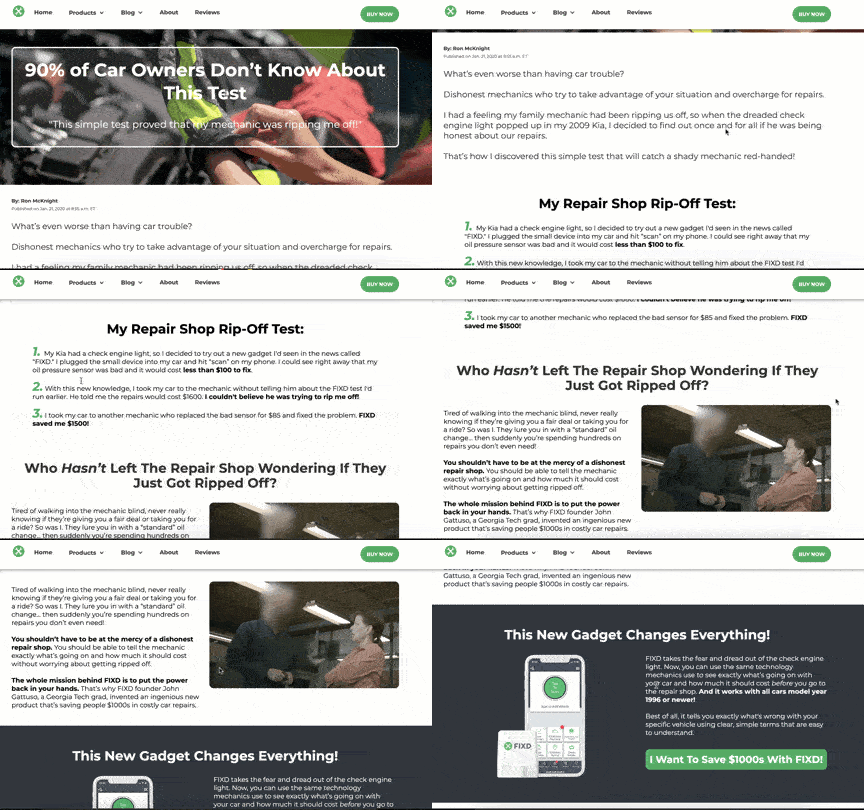
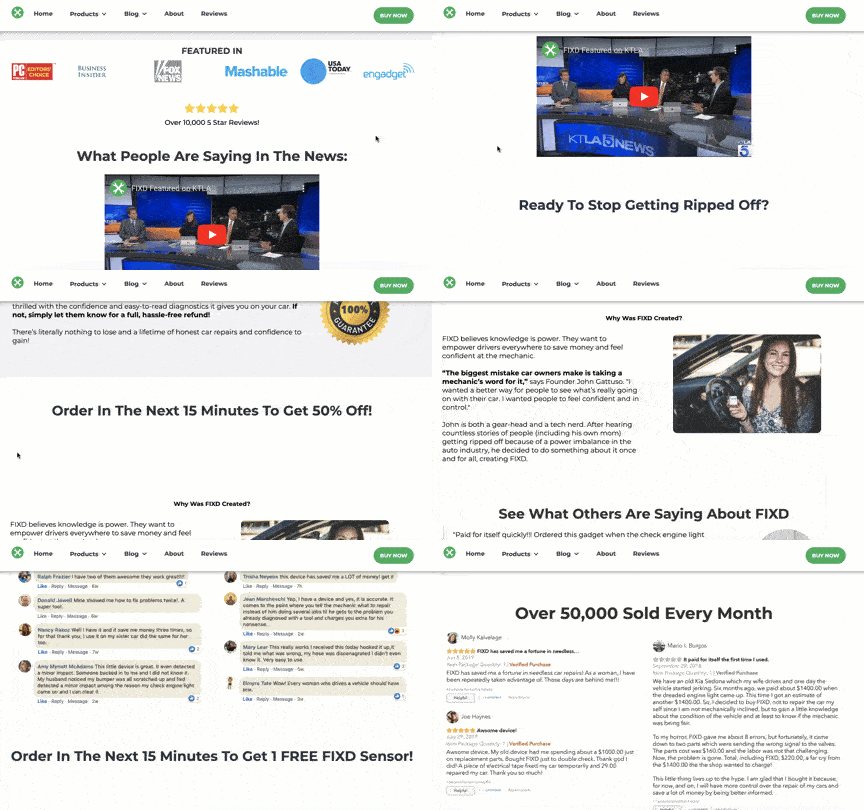

The architecture:
- Advertorial #1 — problem-and-solution framing. “Most people don't know X about their car. Here's what happens when you don't. Here's a better approach.” Reads as editorial. Links to advertorial #2.
- Advertorial #2 — social proof consolidation. Featured-in logos + review aggregation + customer story + news-style video embed. Links to the product page.
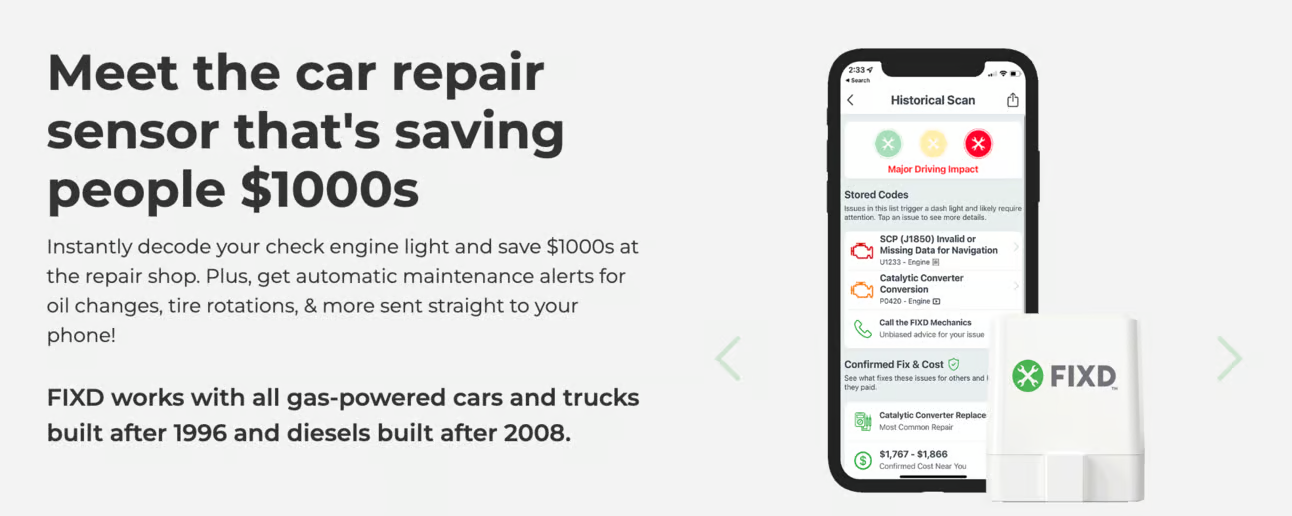
- Product page — buyer arrives pre-sold twice; their job is just to confirm the offer and complete the transaction.
The 96NORTH translation — exact spec
Advertorial #1 — “How to choose a clean-burning candle (and why most brands hide what's in their wax)”
| Section | Content | Word count |
|---|---|---|
| Headline | “How to choose a clean-burning candle — and why most brands hide what's in their wax” | 15 |
| Byline | Bylined by a wellness/home writer persona (“By Sarah Chen, Home & Wellness Contributor”). Date at top. | — |
| Hook (1st para) | Personal story: writer describes getting headaches from candles in their new apartment, thinking it was allergies, until someone pointed out paraffin. Sets the emotional context. | 120 |
| Problem expansion | Paraffin wax is petroleum-derived; burns release known combustion byproducts. Most premium-priced candles use paraffin or paraffin blends to cut costs, including some brands priced at $40+. | 220 |
| Mechanism intro | Transitions to “the fix.” Introduces 3 criteria for clean-burning: wax type (100% soy or coconut), wick material (cotton, not zinc-core), fragrance source (essential oils / aromatherapy-grade, not synthetic fragrance). | 180 |
| Product discovery | Writer ends up trying 3–4 brands. Soft product mention: “One brand I kept coming back to was 96NORTH — a mid-priced premium line that met all three criteria and advertised 50-hour burn time.” Not a hard sell; feels like editorial. | 140 |
| CTA into Advertorial #2 | “I tested 96NORTH for 30 days — here's what I found →” | 15 |
Total length: ~700 words. Reading time ~3 min. The CTA to Advertorial #2 frames the next page as a continuation of the story, not a sales page.
Advertorial #2 — “I tested 96NORTH candles for 30 days — here's what I found”
| Section | Content |
|---|---|
| Headline | “I tested 96NORTH candles for 30 days — here's what I found” |
| ATF | Same byline. Photo of the writer (stock model) with the candle. Side-note: “In partnership with 96NORTH.” (Required FTC disclosure, kept light.) |
| Burn-time test | Writer burns a 3-wick for 50 hours over 2 weeks. Photo series: Day 1, Day 7, Day 14. Burn pool edge-to-edge throughout. Quantitative proof. |
| Scent-throw test | Writer tests in 3 room sizes. Scent holds. Specific observations (floral notes, depth, no chemical top-note). |
| Headache test | Writer reports no headaches after multi-week daily use. Contrasts with prior experience. |
| Social proof block | “96NORTH is also one of Amazon's top-rated candles: 1M+ customers, 4.5+ star average.” Press logos if we get any (e.g., Real Simple, House Beautiful) — but real or none. Don't fabricate. |
| UGC / review callouts | 3–4 reviews pulled from Amazon with reviewer names. Each review addresses a different hesitation (burn time, scent throw, giftability). |
| CTA to product page | “Check availability + current bundle offer →” Destination: 96north.com homepage with UTM so it's tracked as advertorial traffic. |
Total length: ~900 words. Reading time ~4 min. 80% CTR to the product page at this stage is the FIXD benchmark; we expect similar given matched structure.
The “fragrance decay” angle as second advertorial option
From the Manus PDF, an unexpectedly strong angle for a second advertorial variant: the category-wide conversion collapse. Writer explains that 4 of 5 major premium candle brands saw their actual customer quality drop in 2026 as they chased Meta traffic without backing it with product truth. 96NORTH's Amazon-first model means their product speaks for itself — the advertorial becomes a “here's who you can trust in a saturated market” piece.
A/B test the two ad-1 angles (clean-burn education vs. category-distrust framing) once both are written. We expect clean-burn to outperform for cold traffic; category-distrust for warmer retargeting.
Traffic flow
| Step | Destination | Expected rate |
|---|---|---|
| Meta ad (Idea 04 creative) | → Advertorial #1 | CTR ~1.5–2.5% |
| Advertorial #1 | → Advertorial #2 | CTR ~30% (FIXD benchmark) |
| Advertorial #2 | → 96NORTH homepage | CTR ~80% (FIXD benchmark) |
| Homepage (per Idea 05 spec) | → PDP → add to cart | Conversion 2.5–4% |
Compound: 1.5% × 30% × 80% × 2.5% = 0.009% ad-to-purchase. That sounds low but at $30 CPMs it's a CPA of ~$33 against an LTV-backed CAC budget of $60–100 (membership-driven), which is the inversion point for Meta being profitable.
Why this only works once Ideas 01–05 exist
Build (3–4 weeks)
| Week | Work |
|---|---|
| 1 | Write Advertorial #1 (2 angles for A/B) + Advertorial #2. Freelance writer (~$1K/article from a direct-response copywriter; this is the single most important spend of the project). |
| 2 | Design: editorial-style templates. Mobile-first, clean typography. Hosted on lp.96north.com or Shopify pages — matter of access. |
| 3 | QA + legal review (FTC disclosure language). Set up UTMs so advertorial traffic is isolated in analytics. |
| 4 | Launch against 10% of Meta spend first. Compare advertorial funnel CPA vs direct-to-homepage CPA at same spend. Scale up if pencils. |
Watch-outs
- FTC compliance. “In partnership with” or “sponsored” disclosure is mandatory once we're paying for the advertorial ad spend. A FOTW-native pattern to borrow: make the disclosure visually unambiguous but not above the fold — this is legally compliant and doesn't kill conversion.
- Don't lie. Everything in the advertorial should be literally true. If the writer didn't actually burn a candle for 30 days, don't claim they did; use the UGC/reviews angle instead. Meta and Google both remove advertorials for fabricated testing.
- Landing-page speed. Advertorials are text-heavy. If they load slowly on mobile, CTR collapses. Use static HTML or lightweight Shopify pages; avoid Elementor/WebFlow if possible.
- Evidence gap. Our pattern library has FIXD's CTR benchmarks; we do NOT have a direct candle-category advertorial exemplar. The 30%/80% CTR numbers come from an automotive-DTC brand (FIXD), and while the double-advertorial pattern has been ported successfully to supplements, beauty, and home goods (per pattern library), it has not been validated specifically in the candle vertical.